Week 4 · Module 3
Financial Intermediation and Crises
Financial Institutions and Markets · MF50004.01
Prof. Jiajun Jiang · School of Economics, Fudan University · Semester 1, 2026–2027
Where we left off
Two bonds with the same maturity trade at different yields because of default risk, liquidity and tax treatment, and the same borrower pays different rates at different maturities. We then measured risk: in a portfolio, what matters is how an asset moves with the others, which leads to beta and the Capital Asset Pricing Model. Finally we asked whether market prices are right: depending on the method, between 35% and 82% of published anomalies survive when other researchers rebuild them.
Weeks 2 and 3 priced assets as if buyer and seller knew the same things. A lender usually knows much less than the borrower. This week asks what follows from that gap: why most firms borrow from banks instead of selling shares or bonds, why loan contracts look the way they do, and what happens when the gap becomes so large that lending stops — a financial crisis, in the United States and in China.
This week
- Why intermediaries exist
- Asymmetric information and contract design
- The stages of a financial crisis
- China: stimulus, shadow banking and Baoshang
Mishkin Chapters 7 and 8. One problem runs through all four sessions: one side of a financial contract knows something the other side does not.
Meeting 1
Session 1 · Why intermediaries exist
Session 2 · Asymmetric information and contract design
90 minutes · why banks and other intermediaries exist, and how contracts deal with hidden information · closes on private credit, a $1.5–2.0 trillion market of non-bank loans
Session 1 · 45 minutes
Why intermediaries exist
- How firms raise money: Mishkin’s eight facts about financial structure
- Transaction costs, and how intermediaries reduce them
- Two Chinese cases where technology tried to cut those costs: robo-advisers and peer-to-peer lending
Most of the eight facts contradict what a model without frictions would predict, and each can be explained by a specific friction.
Predict before we look
Predict before reveal · show of hands · 3 min
In the United States, Germany, Japan and Canada, 1970–2000, roughly what share of firms’ external finance came from issuing new shares?- About 40%
- About 25%
- About 10%
- Under 5%
Whatever you answer, ask yourself why the stock market gets most of the news coverage.
Where firms get their external funds
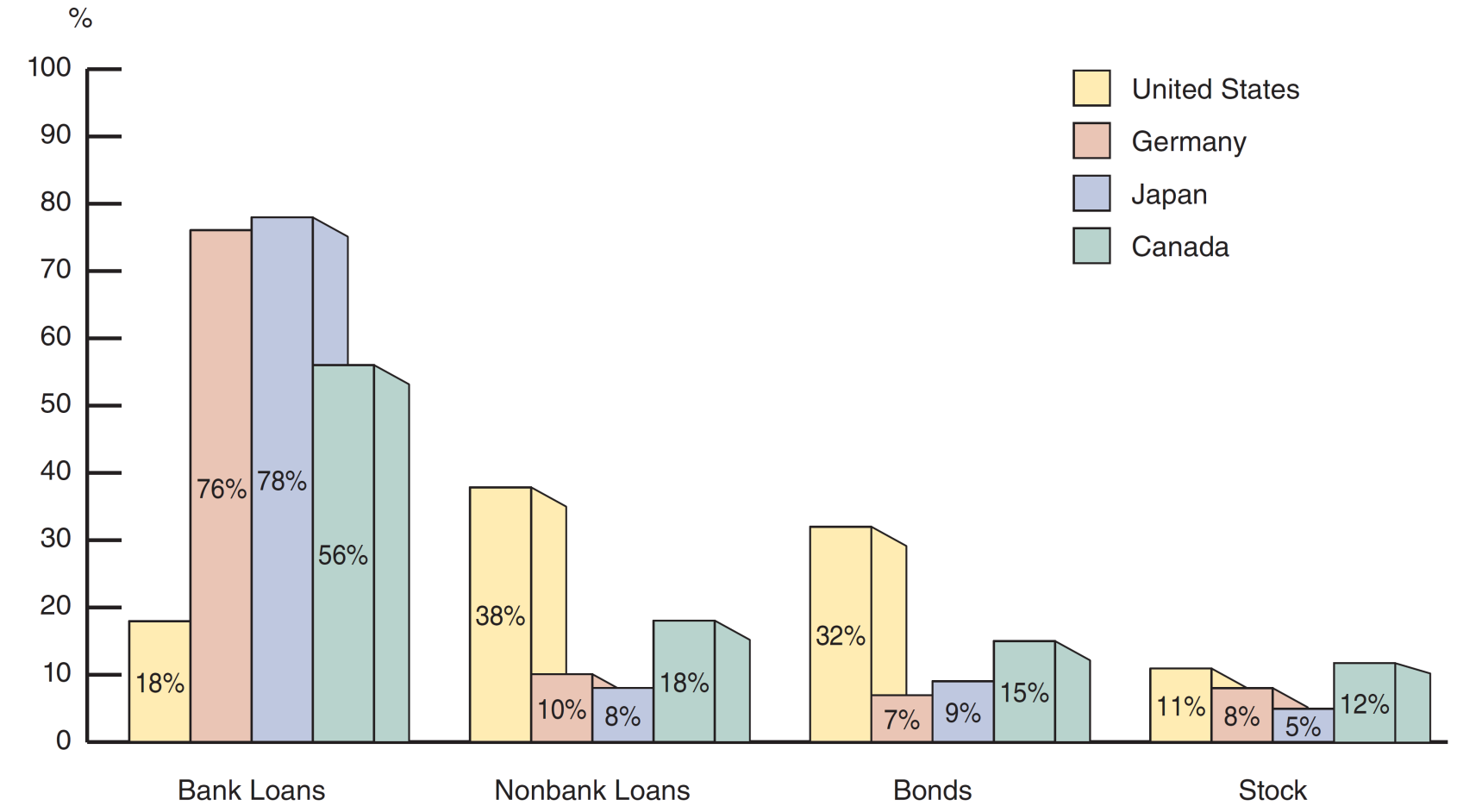
New shares were 11% of firms’ external finance in the US, 8% in Germany, 5% in Japan and 12% in Canada. Bank loans were 18%, 76%, 78% and 56%.
Mishkin & Eakins, 9th Global Edition, Figure 7.1; averages for 1970–2000. China in 2025: loans were 45% of new aggregate financing to the real economy and bonds plus shares 47%, but 39 points of that 47 were government bonds; firms’ own bonds and shares were 8% (PBoC, 15 January 2026).
Eight facts about financial structure
| 1 | Stocks are not the most important source of external finance for businesses |
| 2 | Marketable securities are not the primary source of finance either |
| 3 | Indirect finance is many times more important than direct finance |
| 4 | Banks are the most important source of external funds |
| 5 | The financial system is among the most heavily regulated sectors of the economy |
| 6 | Only large, well-established firms have access to securities markets |
| 7 | Collateral is a prevalent feature of debt contracts |
| 8 | Debt contracts are extremely complicated legal documents with substantial restrictive covenants |
Facts 1 to 4 show that intermediaries do something markets cannot. Facts 6 to 8 show that it concerns information.
Transaction costs
A deposit can be withdrawn any day, while the loans it funds run for years. Savers value that for its own sake. It is Week 1’s maturity transformation, seen from the saver’s side.
Transaction costs explain why intermediaries exist. They do not explain why most external finance is debt, or why loan contracts are so long. For that we need information.
Mishkin & Eakins, 9th Global Edition, Chapter 7.
Robo-advisers in China, 2016–2026
Cold call · 4 min
The bank that ran the robo-adviser also sold the funds it recommended, and earned a fee on every sale. What risk does this create for the client?Permanent rules, the Measures for Securities and Fund Investment Advisory Business, appear in the CSRC’s April 2026 legislative plan only as “to be issued when appropriate”; no draft had been published by September 2026. Caijing, 21 July 2026; CSRC.
The rise and fall of peer-to-peer lending in China
Peer-to-peer (P2P) platforms were websites that matched individual lenders with individual borrowers. With almost no regulation until 2015, the sector grew sixty-fold between 2013 and 2017. Most platforms promised investors their money back. With that promise they were in effect banks, but with no capital, no deposit insurance and no supervisor. By mid-November 2020 the regulator said every operating platform had closed.
Ding, Kavuri & Milne (2021), Journal of Banking Regulation 22; Guo Shuqing, then chairman of the China Banking and Insurance Regulatory Commission, December 2020 (BIS). Peak lending volume ¥2.8tn in 2017.
Session 2 · 45 minutes
Asymmetric information and contract design
Adverse selection happens before the transaction: the borrowers most eager to borrow are often the ones you least want to lend to. Moral hazard happens after: once they have your money, the borrower may use it in ways you would not have agreed to.
Most clauses in a real loan contract deal with one of these two problems.
The lemons problem
An investor who cannot tell a good firm from a bad one offers the average price. Good firms find that price too low and do not issue. The market is left with the firms you would least like to fund — which is Mishkin’s Fact 6, derived from theory.
Akerlof (1970): when buyers cannot judge quality, a market can shrink until it disappears. In American English a “lemon” is a used car with hidden defects.
What reduces adverse selection
| Device | How it works | Who supplies it |
|---|---|---|
| Private information production | Someone investigates firms and sells the answer | Rating agencies, analysts |
| Government-mandated disclosure | Standardised, audited, comparable, compulsory | Securities regulators |
| Financial intermediation | The lender keeps the loan, so its information stays private and is worth producing | Banks |
| Collateral and net worth | The lender is repaid even if the borrower turns out to be bad | The contract itself |
If you research a firm and buy its securities, others see the price move and copy you for free, so less research gets done. A bank avoids this by making a private loan that nobody can copy — one reason banks were the largest source of firms’ external funds in Mishkin’s data (Facts 3 and 4).
Moral hazard, and why most external finance is debt
Managers own a small share of the profits but do all of the work. To know what they are owed, shareholders must check the firm’s results in every period, and checking is expensive.
A fixed payment means the lender needs to check nothing as long as the payment arrives. Costly checking happens only in default, and default is rare.
Debt saves on monitoring. Mishkin calls the cost it saves costly state verification, and it is one reason firms raise much more through debt than through new shares (Fact 1).
Debt has its own moral-hazard problem: a borrower who keeps the gains of a risky project but shares its losses with the lender will prefer risk.
Worked example: how debt changes the borrower’s choice of project
Two projects. Safe: pays 95 for certain. Risky: pays 140 with probability ½, or 40 with probability ½ — expected value 90, so it is the worse project.
| Project | Firm value | Lender receives | Owner receives |
|---|---|---|---|
| Safe (certain) | 95 | 95 | 0 |
| Risky, good half | 140 | 100 | 40 |
| Risky, bad half | 40 | 40 | 0 |
| Risky, expected | 90 | 70 | 20 |
The owner prefers the project that destroys value: 20 against 0. The lender pays for it: 70 against 95. With limited liability the owner keeps the upside and passes the downside to the lender.
When the information producer has a stake
| Institution | The two businesses | The conflict |
|---|---|---|
| Investment banks | Underwriting (selling a firm’s new securities) and research | Research that hurts a client costs the underwriting fee |
| Accounting firms | Auditing and consulting | A tough audit costs the consulting work |
| Rating agencies | Rating and advising on structure | The issuer pays, and can choose the agency that rates it highest |
Enron hid debt in off-balance-sheet companies; its auditor, Arthur Andersen, also sold it consulting services. Enron’s collapse brought down Andersen and led to the US Sarbanes-Oxley Act (2002), which bars a firm’s auditor from selling it many non-audit services.
In each case the producer of information is paid by the firm it is supposed to judge.
Diagnose the friction
Think – pair – share · 6 min
For each, say whether it addresses adverse selection or moral hazard, and how: a mortgage requiring a 30% deposit; a bond covenant limiting new borrowing; a bank demanding three years of audited accounts; a venture capitalist taking a board seat.Case — private credit: non-bank lenders to mid-sized firms
Think – pair – share · 10 min
Choose A or B, then name the one piece of information.Financial Stability Board, Report on Vulnerabilities in Private Credit, 6 May 2026; market size as at end-2024.
Meeting 2
Session 3 · The stages of a financial crisis
Session 4 · China: stimulus, shadow banking and Baoshang
90 minutes · what a financial crisis is, in the United States and in China · closes on Baoshang Bank, 2019
Session 3 · 45 minutes
The stages of a financial crisis
Mishkin’s definition: a disruption in which asymmetric information problems become so severe that the financial system stops channelling funds to those with productive investment opportunities.
The definition does not mention falling asset prices. Prices usually fall in a crisis, but what makes it a crisis is that lending stops.
Three stages
A bank’s knowledge of its borrowers cannot be handed to another lender. When the bank fails, that knowledge is lost, and the borrower’s access to credit goes with it.
Stage three did not happen in 2008 or 2023. It did happen in the 1930s, and it is one reason central banks fear deflation.
The sequence, in full
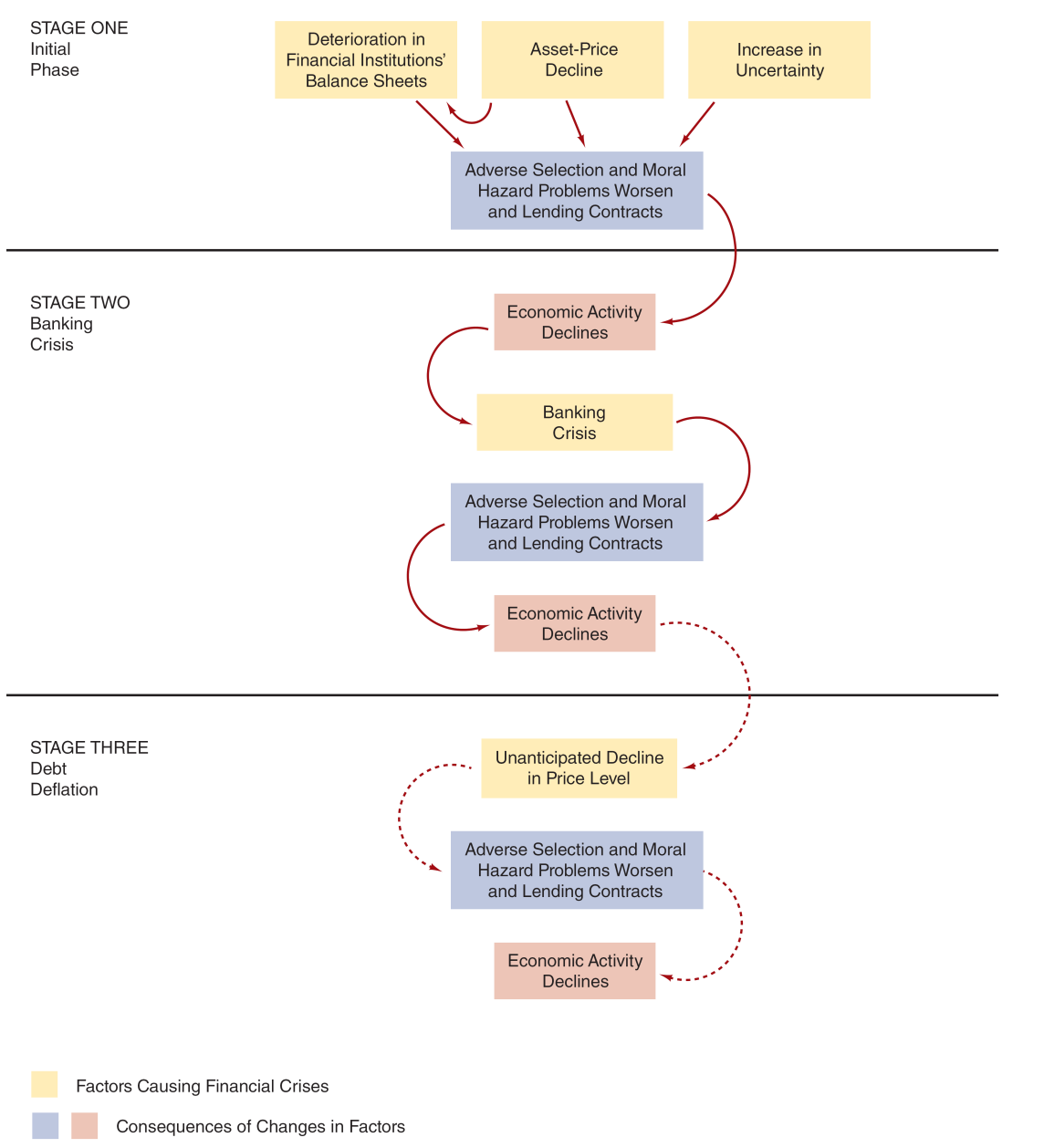
Mishkin & Eakins, 9th Global Edition, Figure 8.1.
2007–09, through the three stages
| Stage | What happened in the United States |
|---|---|
| 1 · Credit boom | Subprime mortgage lending grows on the belief that house prices never fall nationally; the loans are pooled into securities and sold to investors |
| 1 · Asset-price bust | House prices turn in 2006. Nobody can value the mortgage securities, so they become unsellable — the lemons problem |
| 1 · Balance sheets | Losses meet high leverage; short-term lenders refuse to roll over their loans |
| 2 · Banking crisis | Bear Stearns rescued (March 2008), Lehman Brothers bankrupt (September 2008); banks stop lending to each other |
| 3 · Debt deflation | Did not happen: US consumer prices fell 0.4% in 2009, then rose again |
Cold call · 3 min
After Lehman failed, banks stopped lending to each other, even to banks that were sound. Which Session 2 problem explains that?Research Spotlight
- Question
- Did the banks that packaged mortgages into securities tell investors the truth about the loans, and did investors notice when they did not?
- Identification
- The loan data reported to investors in residential mortgage-backed securities (RMBS) compared with an independent record of the same loans, on two facts that are easy to check: whether the borrower had a second mortgage on the house, and whether the borrower lived in it. Then default rates and issue prices compared against otherwise similar loans
- Number
- 7–14% of loans misreported; about 70% higher default rate; no price discount for the pools that contained them
- So what
- The seller knew more than the buyer, exactly as in Akerlof, but buyers did not pay less. Securitisation passed the information problem on to investors, who did not price it
Piskorski, T., Seru, A. & Witkin, J. (2015). Asset Quality Misrepresentation by Financial Intermediaries: Evidence from the RMBS Market. Journal of Finance 70(6): 2635–2678.
March 2023 — the same sequence, in 48 hours
SVB’s losses were on Treasury bonds and mortgage securities that fell in price when rates rose, and its depositors could leave within hours.
Federal Reserve, Barr Review, 28 April 2023; FDIC failed bank list. Assets at failure: SVB $209bn, Signature $110.4bn, First Republic $229.1bn.
Who paid for protecting all depositors
On 12 March 2023 the Treasury, the Federal Reserve and the Federal Deposit Insurance Corporation (FDIC) protected all depositors at SVB and Signature Bank, insured or not. The cost to the FDIC’s Deposit Insurance Fund: about $16.7 billion on its latest estimate.
The FDIC recovered the cost with a special assessment on each bank’s uninsured deposits above the first $5 billion, collected over eight quarters to March 2026. Banks with less than $5bn of assets paid nothing. In effect it charged, after the event, the banks that benefit most from an implicit guarantee.
Deposits above the limit were protected although the law did not require it. That protection is a subsidy, and the policy question is who should pay for it in advance.
FDIC, special assessment page (estimate as of 30 September 2025); Federal Register, 29 November 2023 and 19 December 2025.
Social media and the speed of a bank run
Banks that were already discussed more on Twitter before March 2023 lost about 4.3 percentage points more stock-market value during the run than otherwise similar banks — holding constant their share of uninsured deposits and their losses on securities.
The $250,000 limit was set when withdrawing money took time. When depositors share news online and can move money by phone within minutes, uninsured deposits can leave much faster.
Mishkin’s stage one is about balance sheets. How quickly depositors receive news and move money now matters as well.
Cookson, Fox, Gil-Bazo, Imbet & Schiller (2026), Journal of Financial Economics 176.
Deposit insurance is a design choice
| Jurisdiction | Limit per depositor | Note |
|---|---|---|
| United States | $250,000 | Per ownership category |
| Euro area | €100,000 | Harmonised across member states |
| United Kingdom | £120,000 | Raised from £85,000 in December 2025 |
| Japan | ¥10 million | |
| China | ¥500,000 | In force since 1 May 2015; the People’s Bank of China calculates it covers 99.6% of depositors in full |
For run risk, what matters is the share of deposits covered, and that differs from the share of depositors. At SVB 94% of the money was above the limit.
Should deposit insurance have a limit?
Poll · show of hands · 3 min
Should deposit insurance cover all deposits in full, with no limit?- Yes — the limit was not applied in 2023, so the rule should match practice
- No — uninsured depositors are the main outside check on a bank
- Yes, but charge for it: unlimited cover with a premium based on each bank’s risk
- Keep the limit, and let large depositors take losses next time
Session 4 · 45 minutes
China: stimulus, shadow banking and Baoshang
China did not have a banking crisis in 2008. It had a very large credit expansion instead, and the consequences appeared over the following decade in a form Mishkin’s three stages do not describe.
The chain: stimulus → a borrowing constraint → shadow credit → an implicit guarantee → the day the guarantee was withdrawn.
The 4-trillion stimulus
Local governments had to carry out much of the spending and had no legal way to borrow. They borrowed through local government financing vehicles (LGFVs) — companies they set up to borrow for them — mostly as bank loans, with bank-loan maturities.
State Council announcement via Library of Congress; Naughton (Hoover Institution); new renminbi loans from the People’s Bank of China.
When the stimulus loans came due
Small and mid-sized banks that competed for deposits with the large state banks sold wealth-management products — savings products outside the bank’s balance sheet — as substitutes for deposits, which had to be rolled over every few months (Acharya, Qian, Su & Yang, 2025).
Chen, He & Liu (2020), Journal of Financial Economics 137(1); Acharya, Qian, Su & Yang (2025), Management Science 71(7).
Chinese shadow banking, 2016–2024
Shadow banking here means credit provided outside banks’ balance sheets: trust loans, entrusted loans, wealth-management products and similar channels, on Moody’s broad measure.
From about 87% of GDP at end-2016 to about 40% at end-2024. In yuan the total stopped falling: ¥49tn in 2023, ¥53.3tn in 2024.
Moody’s Quarterly China Shadow Banking Monitor (2016, 2021); BBVA Research, China Banking Monitor 2025, estimates based on Moody’s (2023, 2024). No 2025 figure has been published, so the series stops there.
Baoshang Bank, 2019–2020 — what was done
| Date | Action |
|---|---|
| 24 May 2019 | The People’s Bank of China and the banking regulator take control of Baoshang, a city commercial bank in Inner Mongolia. The cause: about ¥156bn of fraudulent loans to 209 shell companies linked to one group |
| Same day | Personal deposits protected in full. Interbank and corporate claims protected in full only up to ¥50m; larger claims negotiated. Interbank borrowing was about 44% of Baoshang’s liabilities |
| Apr 2020 | Good assets moved to a new bank, Mengshang, with money from the Deposit Insurance Fund |
| Nov 2020 | ¥6.5bn of Tier-2 capital bonds (bank bonds that absorb losses) written down to zero on 13 November, a first in China; declared bankrupt in February 2021 |
Regulators had taken over troubled banks before and always paid creditors in full. The new step was a loss for large interbank creditors.
Xu, Liu & Zhang (2024), Finance Research Letters 59, 104696; Liu, Wang & Zhou, BOFIT Discussion Paper 11/2024.
Predict before we look
Predict before reveal · show of hands · 3 min
Chinese banks borrow from each other by selling negotiable certificates of deposit (NCDs), short-term debt securities. In the eleven days after the Baoshang announcement, what happened to the share of banks that tried to sell NCDs and could not?- It barely moved — from about 8% to about 11%
- It roughly doubled, to about 17%
- It rose to about 43%
- Almost no small bank could sell one
After Baoshang: funding costs for other banks
Before Baoshang, the interest rate a bank paid on its NCDs hardly depended on the bank’s own financial condition. Afterwards it did — but only for small banks whose failure would not threaten the whole system.
The interbank market became tiered: an NCD is now priced on how important the issuing bank is thought to be. Spreads had mostly returned to normal by end-2019.
Liu, Wang & Zhou, BOFIT Discussion Paper 11/2024 (working paper).
Closing case — Baoshang and the next small-bank failure
Think – pair – share · 10 min
Choose A or B, give one reason from this week, and say what you would watch over the next five years to know you chose well.Main takeaways
- Why intermediaries exist: the eight facts, transaction costs, and two Chinese FinTech cases
- Asymmetric information: adverse selection, moral hazard, and how contracts deal with them
- Financial crises: Mishkin’s three stages, 2007–09 and March 2023
- China: the 2008 stimulus, shadow banking, and the Baoshang takeover
- New shares were only 5–12% of firms’ external finance in the US, Germany, Japan and Canada
- Adverse selection happens before the contract, moral hazard after; disclosure, collateral, covenants and bank monitoring each answer one of them
- With limited liability the owner chose the worse project: 20 for the owner, and the lender’s expected payment fell from 95 to 70
- A crisis has three stages: balance sheets worsen, banks fail, debt deflation. 2008 and 2023 stopped at stage two
- SVB: 94% of deposits uninsured; all depositors were protected, and large banks were charged afterwards
- Baoshang: claims above ¥50m lost protection, and banks unable to sell an NCD rose from 8.3% to 43.1% in eleven days
Questions to Think About
- Misreported mortgage pools sold at no discount. Give two explanations, and one observation that would tell them apart.
- Private credit serves the firms of Fact 6 outside bank regulation. Is the financial system more or less stable as a result?
- China withdrew an implicit guarantee and prices became informative; six banks then needed rescuing. Was it worth doing?
- If bank runs now happen in hours, which banking rule most needs to be revised?
These are for you to think about, not to hand in.
Before Next Class
- Mishkin & Eakins — Chapters 7 and 8 (this week)
- Mishkin & Eakins — Chapters 9 and 10, central banks and monetary policy (Week 5)
- Piskorski, Seru & Witkin (2015), Journal of Finance — today’s Research Spotlight; read the introduction
- Chen, He & Liu (2020), Journal of Financial Economics — how the 2009 stimulus loans turned into shadow credit
- FSB, Report on Vulnerabilities in Private Credit, 6 May 2026 — the executive summary
Week 5 begins tomorrow, Friday 16 October, with central banks and monetary policy. Monday 19 October is FinTech.
References
- Acharya, V. V., Qian, J. “QJ”, Su, Y. & Yang, Z. (2025). Fiscal Stimulus, Deposit Competition, and the Rise of Shadow Banking. Management Science 71(7): 5645–5675.
- Akerlof, G. A. (1970). The Market for “Lemons”. Quarterly Journal of Economics 84(3): 488–500.
- Chen, Z., He, Z. & Liu, C. (2020). The Financing of Local Government in China. Journal of Financial Economics 137(1): 42–71.
- Cookson, J. A., Fox, C., Gil-Bazo, J., Imbet, J. F. & Schiller, C. (2026). Social Media as a Bank Run Catalyst. Journal of Financial Economics 176.
- Ding, D., Kavuri, A. S. & Milne, A. (2021). Lessons from the Rise and Fall of Chinese Peer-to-Peer Lending. Journal of Banking Regulation 22: 133–143.
- Federal Reserve (2023). Review of the Federal Reserve’s Supervision and Regulation of Silicon Valley Bank, 28 April.
- Financial Stability Board (2026). Report on Vulnerabilities in Private Credit, 6 May.
- Liu, L., Wang, X. & Zhou, Z. (2024). Let a Small Bank Fail: Implicit Non-guarantee and Financial Contagion. BOFIT Discussion Paper 11/2024 — working paper.
- Mishkin, F. S. & Eakins, S. G. (2018). Financial Markets and Institutions, 9th Global Edition. Pearson — Chapters 7 and 8.
- Piskorski, T., Seru, A. & Witkin, J. (2015). Asset Quality Misrepresentation by Financial Intermediaries. Journal of Finance 70(6): 2635–2678.
- Xu, Y., Liu, Z. & Zhang, L. (2024). The Spillover Effect of Bank Distress. Finance Research Letters 59, 104696.
Appendix
Optional depth
The full asymmetric-information map, and the numbers on one page.
Appendix — the asymmetric-information map
| Problem | When | Consequence | Reduced by |
|---|---|---|---|
| Adverse selection | Before | The worst borrowers are the most eager; good ones withdraw; the market can disappear | Information production · mandated disclosure · intermediation · collateral and net worth |
| Moral hazard, equity | After | Principal–agent: the manager’s effort is unobserved and their share of the gain is small | Monitoring · board representation · mandated reporting · debt contracts themselves |
| Moral hazard, debt | After | Risk-shifting: limited liability lets the borrower keep the gains of a risky project and pass losses to the lender | Net worth requirements · covenants · collateral · monitoring and enforcement |
| Free-riding on information | Continuous | Researchers cannot capture the value of what they discover, so too little is produced | Private lending, where the information cannot be copied |
Each of Mishkin’s eight facts follows from one of these four lines.
Appendix — the numbers on one page
| Indicator | Value | As of |
|---|---|---|
| China, new aggregate financing | ¥35.6tn: loans 45%, government bonds 39%, corporate bonds and shares 8% | 2025 |
| Global private credit | US$1.5–2.0tn; bank credit lines ≈$220bn | end-2024 |
| SVB at failure | $209bn assets; 94% uninsured; >$40bn out on 9 Mar; 31 open findings | Mar 2023 |
| Systemic-risk exception | ≈$16.7bn; charged on uninsured deposits above $5bn over eight quarters | 2023–26 |
| China stimulus | ¥4tn (US$586bn), ≈12.5% of GDP; new loans ¥4.9tn → ¥9.6tn | 2008–09 |
| Shadow banking, broad | ≈87% of GDP (2016) → ≈40% (2024); ¥49tn → ¥53.3tn (2023–24) | 2016–24 |
| Baoshang | ≈¥156bn fraudulent loans; full protection to ¥50m; NCD failures 8.3% → 43.1% | May–Jun 2019 |
Sources on the slides where each figure appears.